
Guide
How to Help Someone Who Will Not Admit They Have a Drinking Problem
Joint Commission accredited · In network with most major insurance · Admissions answered 24 hours a day


Published August 17, 2026
You have probably already tried the direct version — said it plainly, maybe more than once, and watched it go nowhere or turn into an argument. That does not mean nothing works. It means the obvious approach is the one least likely to work, and the reasons are worth understanding before you try again.
This is written for whoever is doing the worrying: a wife, a husband, a parent, an adult child, a sibling, a friend.
Denial is usually not a lie
It is tempting to read “I don’t have a problem” as dishonesty. Sometimes it is. More often it is some mix of three things that are harder to argue with:
- A comparison that flatters. They are measuring themselves against the worst drinker they know, not against how they used to be.
- A definition they do not meet. They hold a picture of an alcoholic — unemployed, drinking in the morning, physically wrecked — and being unlike that picture reads as proof.
- Knowing, and not being able to face it. This one looks identical from the outside and is the most common. The denial is protecting them from a conclusion they have already half reached.
That last case matters for your approach. Someone who privately knows does not need more evidence. Piling on evidence makes them defend a position they do not really hold, which is worse than saying nothing.
What tends to backfire
Confronting them while they are drinking. Alcohol impairs judgment and raises reactivity. Nothing said at 10pm on a Friday will be remembered accurately or acted on.
The catalogue. Arriving with a list of every incident feels like justice and lands like a prosecution. The predictable response is to dispute the details, and then the conversation is about whether it was three drinks or five.
Ultimatums you cannot enforce. “If you don’t stop I’m leaving” spends whatever leverage you have. Not following through teaches that your limits are negotiable, and every subsequent statement is discounted.
Covering for them. Calling in sick on their behalf, paying the bill, smoothing it with family. Every rescue removes a consequence that was doing the work of making the problem visible to them.
Waiting for rock bottom. This is folk wisdom, not clinical advice. People get better at many different points, and the wait can be very expensive. There is no threshold you need them to reach first.
What tends to work
Pick a sober, unhurried moment. Morning is usually better than evening, and a weekday better than a weekend.
Speak from what you see, not what they are. “You were asleep before dinner three nights this week and I have been handling the kids alone” is difficult to dispute. “You are an alcoholic” invites a debate about the word.
Ask instead of telling. “Have you thought about cutting back?” or “Does the drinking worry you?” gives them somewhere to go that is not defense. Sometimes the answer is yes, quietly, and they have been waiting to be asked rather than told.
Say what you will do, and only what you will actually do. Small and kept beats large and abandoned. “I’m not going to that with you if you have been drinking” is more powerful than a threat you will walk back.
Let natural consequences stand. Not as punishment. Consequences are the information they are currently being protected from.
Expect to have the conversation several times. People rarely move on the first ask. The value is cumulative, and staying calm keeps the door open for the attempt that lands.
Where we are
Detox centers across Texas
Three locations, each with its own admissions line and its own clinical team. Pick the one nearest you — or call and we will tell you which has a bed tonight.
-
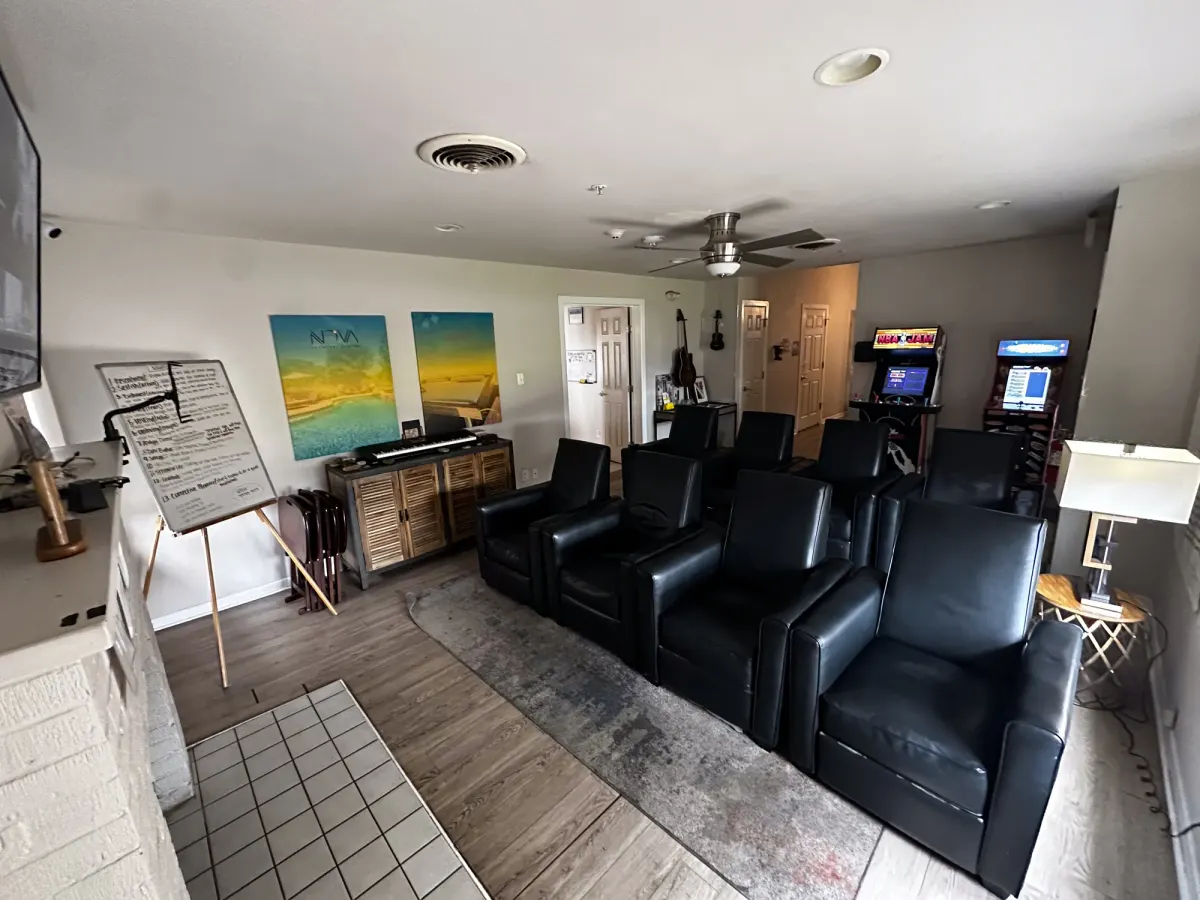 Inpatient
 Austin, TX
11711 N Lamar Blvd · 78753
- 15 beds
- On-site labs
- 24-hour medical staff
Drug & Alcohol Detox in Austin, TX
-
 Inpatient
 Houston, TX
1019 Ashland St · 77008
- On-site labs
- 24-hour medical staff
Drug Detox Center in Houston, TX
-
 Outpatient
 San Antonio, TX
6707 W Hausman Rd · 78249
- Outpatient detox with scheduled medical visits
- Outpatient treatment
Outpatient Drug & Alcohol Detox in San Antonio
The part most advice leaves out
If the person drinks heavily every day, do not push them to stop suddenly on their own.
Alcohol is one of the few drugs where withdrawal itself can kill. Someone physically dependent who stops abruptly can develop seizures or delirium tremens, and the risk is highest in exactly the people a worried family is most eager to see quit immediately. Well-meant pressure to “just stop tomorrow” can be genuinely dangerous.
Signs that dependence is likely:
- Drinking first thing, or needing a drink to steady shaking hands
- Sweating, nausea, anxiety or tremor that a drink relieves
- Drinking through the day rather than in an evening block
- A previous attempt to stop that produced shaking, hallucinations or a seizure
If any of those apply, the goal is not to get them to quit unaided. It is to get them somewhere that can manage withdrawal safely. That is a genuinely useful thing to know before the next conversation, and it changes what you are asking for — not “stop”, but “let’s get you looked at”.
Interventions: sometimes, not always
A formal intervention — several people, a planned meeting, a bed already arranged — can work. It is also easy to do badly, and a botched one can harden someone considerably.
They tend to go better when a professional helps plan it, when everyone present has agreed in advance what they will and will not do, and when treatment is genuinely ready to start that day rather than being an idea. They tend to go badly when they are an ambush, when someone breaks ranks mid-meeting, or when the answer to “and what happens now?” is that nobody has arranged anything.
If a calmer approach has failed repeatedly, an intervention is a reasonable next step. It is not the place to start. Briarwood offers intervention assistance if you want help planning one rather than doing it cold.
Have the logistics ready before the yes
This is the most practical thing on this page.
Willingness is often brief. Someone says yes on a Sunday evening and has talked themselves out of it by Monday lunchtime. If saying yes leads to a week of phone calls and insurance questions, the window usually closes.
So do the boring parts in advance, while they are still saying no:
- Check the insurance and know what it covers, so that question is already answered
- Know where you would call, and whether they can admit the same day
- Ask what happens after withdrawal, because detox alone is not the whole answer
- Sort out the practicalities — work, childcare, the dog, transport
None of this requires their agreement. All of it means that when the yes arrives, the answer is “we can go now” rather than “let me start looking into it”.
Look after yourself while this happens
You are allowed to need support of your own, and it makes you more effective rather than less. Al-Anon and family therapy exist for the people around the drinking, not just the drinker, and Briarwood runs family support alongside treatment for the same reason. Living with someone else’s drinking is genuinely wearing, and running yourself down does not help them.
You also cannot make an adult accept help. You can make it easier to accept, remove the reasons to postpone, and be honest. That is the real extent of the control you have, and it is more than nothing.
Where Briarwood fits
If the signs of physical dependence above sound familiar, medically supervised detox is the safe way to handle the withdrawal stage — monitored, with symptoms treated before they escalate. Inpatient detox is in Austin and Houston; San Antonio is outpatient.
Detox is the start rather than the whole of it. What follows usually matters more:
- Intensive outpatient treatment — structured therapy several days a week while living at home and working, in Austin, Houston and San Antonio. If travel is the obstacle, there is an online option.
- Sober living — a substance-free house with enforced structure, run by Eudaimonia Recovery Homes, part of the same company. Usually lived in while someone is in outpatient treatment rather than after it.
- Residential treatment through Nova, in Wimberley, when someone needs 24-hour care rather than going home each evening.
You can call before they have agreed to anything. Family members ask us what dependence looks like, whether it is safe to stop, and what admission would involve, and none of that requires the person to have said yes yet.
Common questions
Can I make someone go to rehab?+–
For an adult, generally no. Texas has a court-ordered process for emergency situations involving danger to self or others, but it is narrow and not a route to routine treatment. What works in practice is making help easy to accept and letting consequences stay where they fall.
Should I wait for them to hit rock bottom?+–
No. That idea is folk wisdom rather than clinical guidance, and the waiting can be costly. People start treatment at many different points, including under pressure from family, and there is no threshold that has to be reached first.
Is it dangerous for them to stop drinking suddenly?+–
It can be. Someone physically dependent on alcohol who stops abruptly can develop seizures or delirium tremens, which are medical emergencies. If they drink daily, drink in the morning, or have had shaking or hallucinations when stopping before, the safe route is medically supervised withdrawal rather than quitting unaided.
What if they get angry every time I raise it?+–
Anger is usually defensive rather than final. Change the conditions rather than the volume: a sober time of day, one specific observation instead of a list, and a question instead of a verdict. If it still goes nowhere after several attempts, that is the point at which a professional intervention becomes reasonable.
Do I tell them I have looked into treatment?+–
Usually yes, framed as removing obstacles rather than as an ultimatum. Knowing that insurance has been checked and a bed is available takes away the postponement that "I'll look into it" provides.
They said yes but now want to wait a few weeks. What do I do?+–
Treat it as a closing window and try to shorten the gap without turning it into a fight. Ask what specifically needs to happen first, then help remove those obstacles. Most delays are practical — work, money, childcare — and practical problems can be solved by someone who is not the one drinking.
Related guides



About the people behind this guide
Anna-Grace Washington
Medical Content Writer
Anna-Grace Washington is a Medical Content Writer for Briarwood Detox Center. She holds a master’s degree in clinical psychology from the University of Texas and brings a strong understanding of behavioral health, addiction recovery, and evidence-based treatment concepts to her writing.
Dr. Robert Ulrich, DO
Medical Director
Dr. Robert Ulrich serves as Medical Director at Briarwood Detox Center, bringing more than two decades of clinical neurology experience to the treatment of substance use disorders. He is board-certified in neurology by the American Board of Psychiatry and Neurology and completed his neurology residency at UT Southwestern Medical Center in Dallas, where he served as Chief Resident.
In network with most major insurance
Find your plan and see what detox would cost
Most plans cover medical detox. Coverage varies by plan, so we verify it for you before you commit to anything.



















Don't see your plan? We work with out-of-network benefits and offer self-pay options — (866) 710-7710
- Confidential
- Takes about 2 minutes
- No obligation to admit

- Accredited The Joint Commission
- Rated 4.7 · 183 Google reviews Flourishing Foundations Recovery, now part of Briarwood
- Admissions 24 hours a day